Marine Energy Short Courses
Overview
The Atlantic Marine Energy Center (AMEC), together with the other National Marine Energy Centers (NMECs), will be introducing a series of short courses in marine energy to support marine energy research and development. The short courses are supported by funding from the U.S. Department of Energy Water Power Technologies Office (DOE-WPTO) through the Bipartisan Infrastructure Law (BIL).
AMEC will offer these courses across the AMEC partner university campuses starting in Summer 2025, bringing together the breadth of expertise of AMEC faculty to provide students with unique, hands-on, and place-based learning opportunities.
The short courses are structured in three tiers to provide both foundational and specialized content:
Overview of Short Courses at AMEC
Introductory Level
Tailored for students with various disciplinary and interdisciplinary backgrounds, introductory-level courses cover the fundamentals of marine energy with lectures, lab activities, projects, and field trips.
Upcoming and past short courses:
Introduction to Marine Energy at the Coastal Studies Institute, Wanchese, NC, June 1-5, 2026
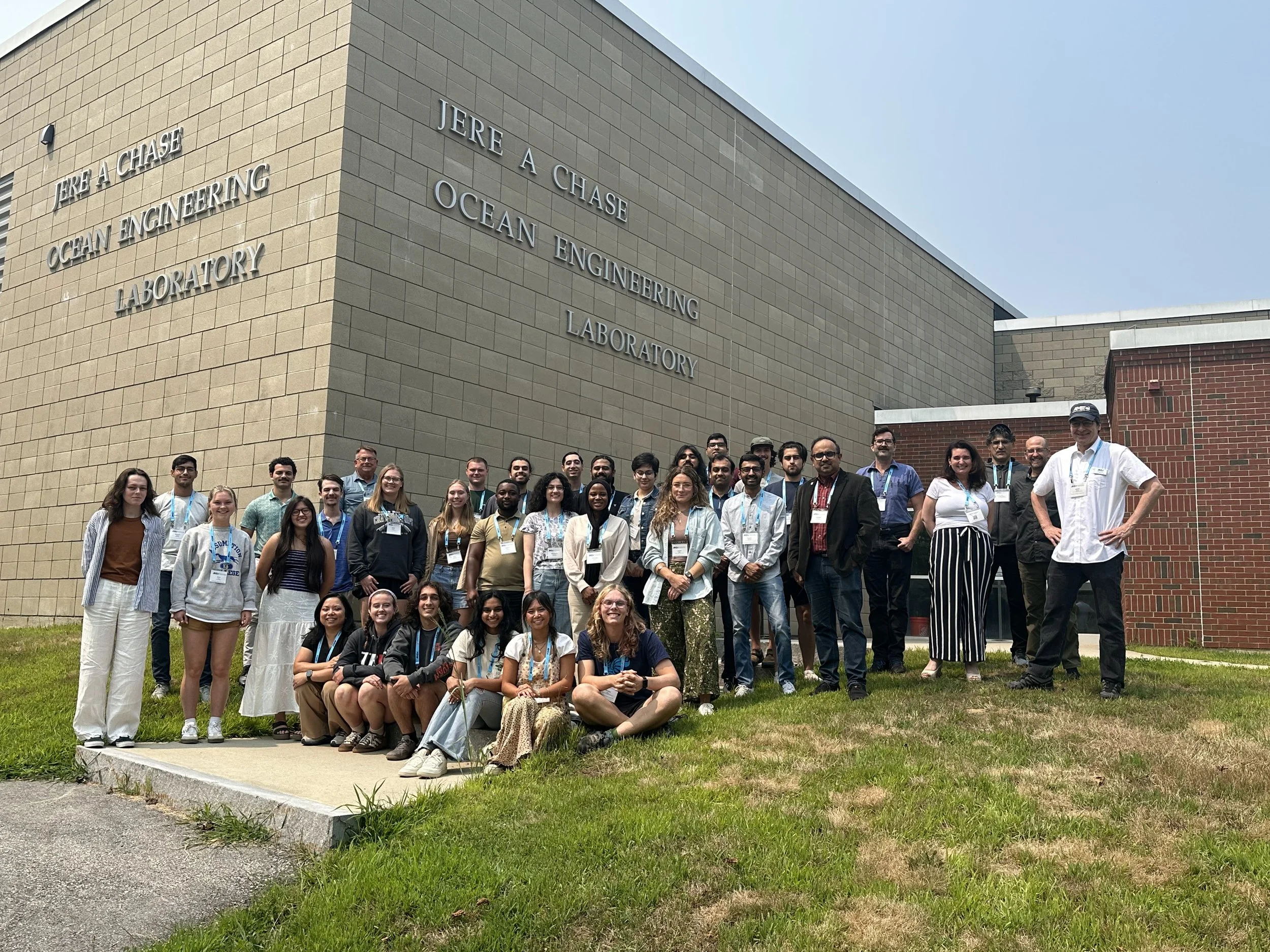
Introduction to Marine Energy at the University of New Hampshire, Durham, NH, August 4-8, 2025
Level 1: Specialized Introductory Courses
These are graduate-level courses that require background knowledge in marine energy, engineering, and other technical skills. These courses will provide a deeper dive into specific marine energy topics, such as tidal and wave energy, as well as related areas, including policy and regulatory issues and stakeholder engagement.
Upcoming courses:
Marine Energy Structures, Materials, and Foundation Systems at Stony Brook University, Stony Brook, NY, June 22-26, 2026
Tidal and Water Current Energy Conversion at University of New Hampshire, Durham, NH, August 10-14, 2026
Level 2: Advanced Courses
These courses are targeted toward advanced M.S. or Ph.D. students pursuing work in specialized areas of marine energy. Example subjects include materials, controls, or turbulence in marine energy.
Note: Information on future courses will be posted when courses have been scheduled.